The Burj Al Arab Jumeirah, known as the ‘World’s Only Seven Star Hotel’, is a showpiece for Dubai’s best real estate developer and for the city’s architecture.
Its sail-shaped structure and height have drawn attention worldwide. The hotel also reflects the UAE’s push to test the limits of contemporary architecture and hospitality, and it comes with a long list of facts worth knowing.
This article covers seven of them. The hotel comes from Jumeirah Group, one of the leading property developers in Dubai. It’s one of many stops on our roundup of must-see places for first-time visitors to Dubai, and one of the top 5 luxury hotels to visit in Dubai.
1. A Sail on the Water
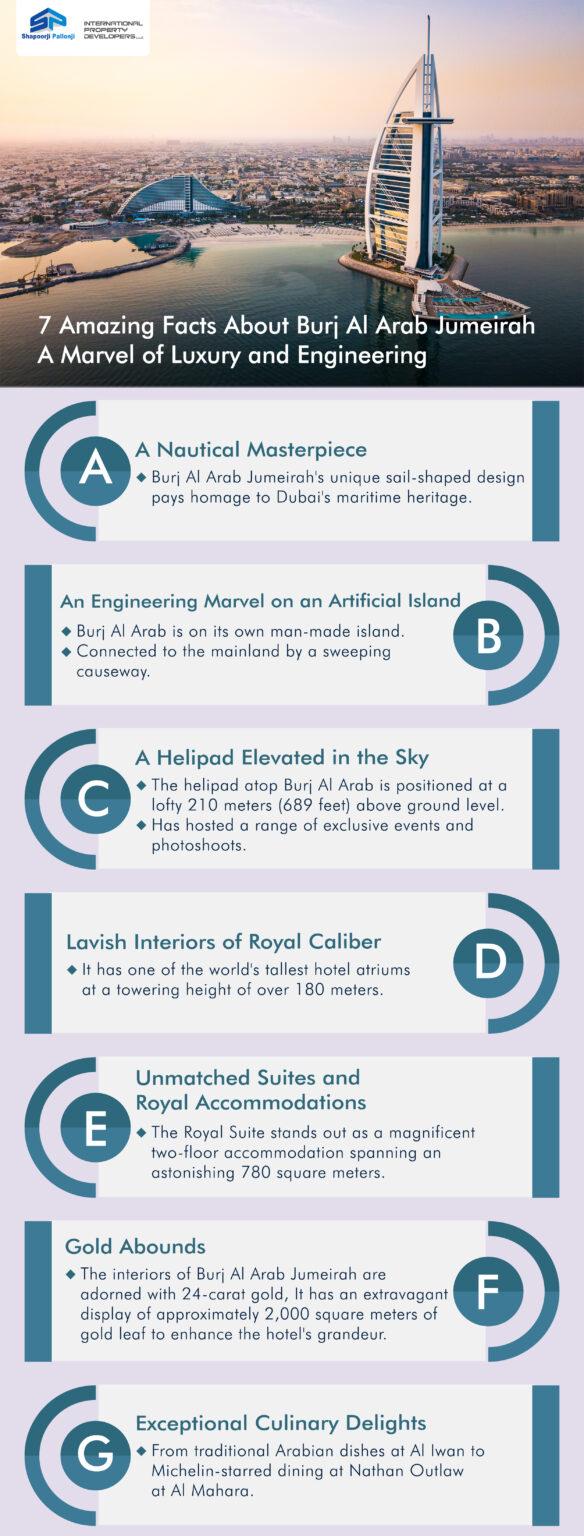
The sail-shaped design is more than a symbol of luxury. It also pays homage to Dubai’s maritime heritage. At 321 metres (1,053 feet), the hotel ranks among the world’s tallest. Architect Tom Wright of WS Atkins designed it, and the sail-like structure is made of Teflon-coated fibreglass. The facade takes on a golden glow, especially at sunset.
2. Built on an Artificial Island
The hotel stands on its own man-made island, connected to the mainland by a sweeping causeway. Building it was a significant piece of modern engineering, and it fits Dubai’s aspiration to create man-made landmarks.
3. A Helipad 210 Metres Up
The helipad sits 210 metres (689 feet) above ground level and looks out over Dubai’s skyline. It has hosted exclusive events and photoshoots, which has made it a distinctive feature of the hotel.
4. Interiors in Marble and Gold Leaf
The interiors use marble, gold leaf and bold colours. The atrium rises more than 180 metres (590 feet), one of the tallest hotel atriums in the world.
5. The Royal Suite
The hotel offers a range of suites. The Royal Suite stands out: two floors spanning 780 square metres (8,396 square feet), with a private cinema, library, revolving bed and wide views.
6. Gold Throughout
The interiors are finished in 24-carat gold, with approximately 2,000 square metres of gold leaf. One of the hotel’s signature restaurants, Al Mahara, is set within an underwater environment, surrounded by a large seawater aquarium. Its centrepiece is a golden staircase.
7. The Restaurants
The hotel has a range of dining options, in the same league as the dining scene at Dubai Mall. They include traditional Arabian dishes at Al Iwan and Italian fine dining at L’Olivo at Al Mahara. The hotel closed for an 18 month restoration on 15 April 2026, and its restaurants stay closed until it reopens, expected around October 2027. Leading property developers in Dubai also build outstanding residential projects in Dubai.
At a glance
| Fact | Detail |
|---|---|
| Opened | 1 December 1999 |
| Construction began | 10 July 1994 |
| Height | 321 metres |
| Distance from shore | About 280 metres, on its own island |
| Suites | 198 duplex suites, per Jumeirah |
| Smallest suite | 169 square metres |
| Royal Suite | 780 square metres over two floors |
| Helipad | 210 metres above ground |
| Atrium | About 180 metres tall |
Suite counts differ between sources, from 198 to 202. We use the operator's own figure. The ‘seven star’ label is a nickname rather than an official rating. Forbes Travel Guide gave the hotel five stars in 2023.
How it was built
Work began on 10 July 1994, and the hotel opened in December 1999. Reclaiming the island took about three years, and the tower itself took less than three. The structure holds more than 70,000 cubic metres of concrete and about 9,000 tonnes of steel. A curved bridge links the island to Jumeirah Beach. Reported building costs vary widely between sources, so we do not quote one.
The helipad has had a second life. In 2005 it hosted an exhibition tennis match between Roger Federer and Andre Agassi, played 210 metres above the ground.
What the restoration changes
This is the first restoration of this scale since the hotel opened. Paris-based interior architect Tristan Auer, whose work includes the Hôtel de Crillon in Paris, is leading it. Jumeirah says 70 to 80% of the existing decor will be kept and restored by artisans rather than replaced. The entry aquarium and the colourful lobby stay, and the spa is being redesigned for better flow. The aim is renewal rather than a new look, so the hotel should still be recognisable when it returns.
What visitors can do now
With the hotel closed, there are no stays or dining reservations to book. The sail is still visible from the Jumeirah coast. Sunset Beach at Umm Suqeim 3 sits directly opposite it, and Kite Beach has it in the frame. Both are free, and our guide to the best beaches in Dubai has the details.
If you want to stay nearby, Marsa Al Arab sits on the same stretch of coast, and Jumeirah Beach Hotel and Madinat Jumeirah are close. Khaleej Times also suggests Atlantis The Royal, the Armani Hotel Dubai and the Four Seasons Resort Dubai at Jumeirah Beach. For more ideas, see our list of luxury hotels in Dubai. If the coast appeals to you as a place to live rather than visit, our guide to desirable locations for property investment is a good start, and our locations page shows where we work.
Conclusion
The Burj Al Arab Jumeirah is more than a luxury hotel. Its sail-shaped architecture, gold interiors, helipad and royal suite reflect Dubai’s ambition and its willingness to try new engineering. For the city, the hotel is also a statement of the guest experience it wants to offer at the top of the luxury market.
FAQ
What are 3 unique features of the Burj Al Arab?
Burj Al Arab is the world’s only seven-star hotel, it has 24-carat gold leaf that stretches 2,000 square metres across the interiors of Burj Al Arab Jumeirah and is settled on its own man-made island.
What are the amazing facts about Burj Al Arab?
Burj Al Arab has a helipad, 24-carat gold interiors, and a unique sail-shaped design.
When did the Burj Al Arab open?
On 1 December 1999. Construction began on 10 July 1994.
How many suites does the Burj Al Arab have?
198 duplex suites, according to Jumeirah. Some sources give 199 or 202. The smallest suite is 169 square metres and the Royal Suite is 780 square metres.
Can you visit the Burj Al Arab now?
Not at present. The hotel is closed for its restoration, so there are no stays or dining bookings. You can see it from Sunset Beach and Kite Beach, and Marsa Al Arab, Jumeirah Beach Hotel and Madinat Jumeirah are nearby.
Who designed the Burj Al Arab?
The building was designed by Atkins, with Tom Wright as the architect. Interior architect Tristan Auer is leading the current restoration.