The Boom That Kept Going
A few years ago, forecasters were calling for roughly 30% cumulative price growth in Dubai real estate by 2025, on the back of record sales and climbing prices. That window has closed, and the more useful question now, in September 2026, isn't whether that specific number landed. It's what the market actually did, and what it's doing today.
What the Data Shows in 2026
The short version: a very strong start to the year, a much weaker second quarter, and prices that eased. The Dubai Land Department recorded AED 252 billion in transactions in Q1 2026 alone, up 31% year-on-year, and AED 419.9 billion across roughly 112,850 transactions for the first half of the year. That total counts every registration: AED 286.4 billion of sales (about 86,000 deals), more than AED 102 billion of mortgages and AED 31.4 billion of gifts. Against the first half of 2025 (AED 431 billion across 125,538 transactions) it is about 3% lower in value and 10% lower in count, and sales alone were about 12% below last year's AED 326.6 billion. The 22% rise in investment value, to AED 173 billion, applies to the first quarter only. Citywide, prices are up roughly 65% over five years (Property Index), but about 3 to 4% below a year earlier in 2026, a softer year after the sharper spikes of 2021 to 2023. For the full area-by-area breakdown, see our capital appreciation deep dive.
The softer prices have an obvious backdrop. A regional conflict involving Iran began on 28 February 2026 and reached the UAE, and sales slowed sharply in March: Goldman Sachs put UAE property transactions down 37% year on year in the first 12 days of the month. A ceasefire was announced on 8 April. ValuStrat’s August index shows Dubai residential values 3.1% lower than a year earlier and about 10% below late February.
Why do the trackers and the DLD seem to disagree? Mostly because they measure different things over different windows. The DLD total includes mortgages and gifts, which grew, while Cavendish Maxwell counts residential sales only and puts sales values for the first eight months of 2026 about 24% below the same months of 2025. January set a monthly record and February was also very strong before the conflict (sales of AED 72.4 billion and AED 60.6 billion), so the first half leans hard on the first quarter. By our calculation from DLD figures, the second quarter on its own was roughly 30% lower in value than the second quarter of 2025, and sales alone about 40% lower. ValuStrat and Property Index track prices, not volumes, so they answer a different question again.
Prices, Area by Area
| Area | Avg. price / sq ft (H1 2026) |
|---|---|
| Palm Jumeirah | ~AED 4,000 |
| Downtown Dubai | AED 2,980 to 3,011 |
| Dubai Marina | AED 2,058 to 2,062 |
| Business Bay | AED 1,450 to 2,547 (wide range, older vs. new stock) |
| Jumeirah Village Circle | AED 1,000 to 1,500 |
What's Driving the Boom Now
- The Golden Visa. A AED 2 million property investment still buys ten-year renewable residency, with no minimum-stay requirement, and since February 2026 no minimum upfront payment on mortgage-financed purchases, a change that's pulled in a wider band of buyers.
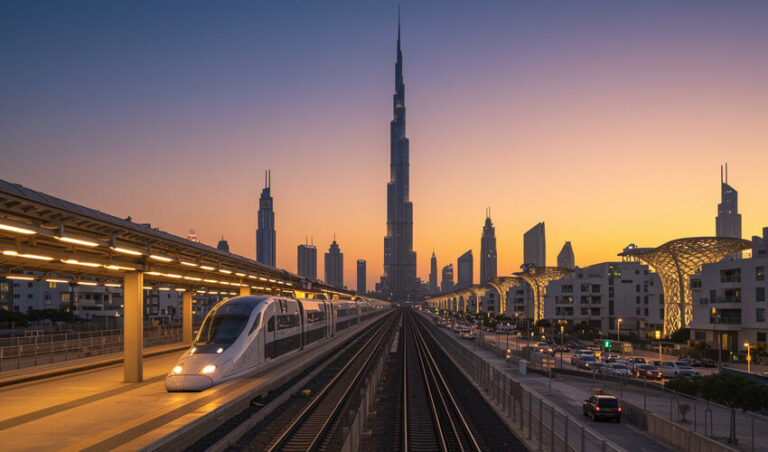
- Infrastructure completing on schedule. Metro extensions and transport links around Expo City and Dubai South keep converting "planned" into "priced in."
- Limited freehold supply in established districts. Downtown and the Marina aren't adding meaningfully more land, so sustained demand shows up in price.
- Population growth. Dubai's population is on a trajectory toward roughly 5.8 million by 2040, and housing demand tends to lead that curve.
Where the Fastest Growth Is Happening
The citywide average masks a wide spread. Emerging districts still completing their infrastructure (Dubai South, the Business Bay canal extension, MBR City) are forecast at 8 to 12% annual appreciation, and several have already posted 30 to 50% cumulative growth since 2023 off a lower base. That's a different, higher-beta story than the mature districts above, and it comes with a different risk profile to match.
Outlook: Is the Boom Sustainable?
Forecasts for the next decade vary widely, and no single cumulative figure is reliable. After a rise of roughly 65% over five years, 2026 has been a softer year, and a flat or slightly negative stretch after a run this strong is not unusual in a maturing market. For a deeper look at what shapes those returns, see our breakdown of 5 factors affecting returns on real estate investments in the UAE. Demand hasn't gone away, but investors should plan around a slower market than the one of 2021 to 2023. If you want to see how that plays out for a specific portfolio, a conversation with a senior advisor costs nothing to start.