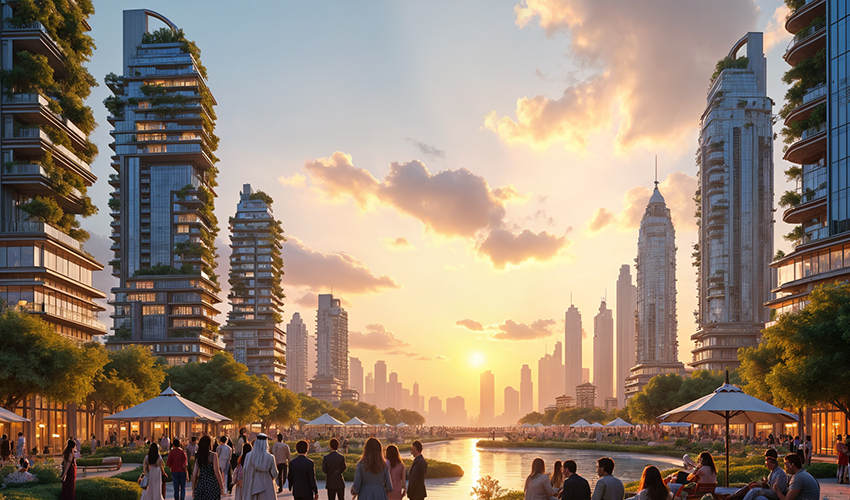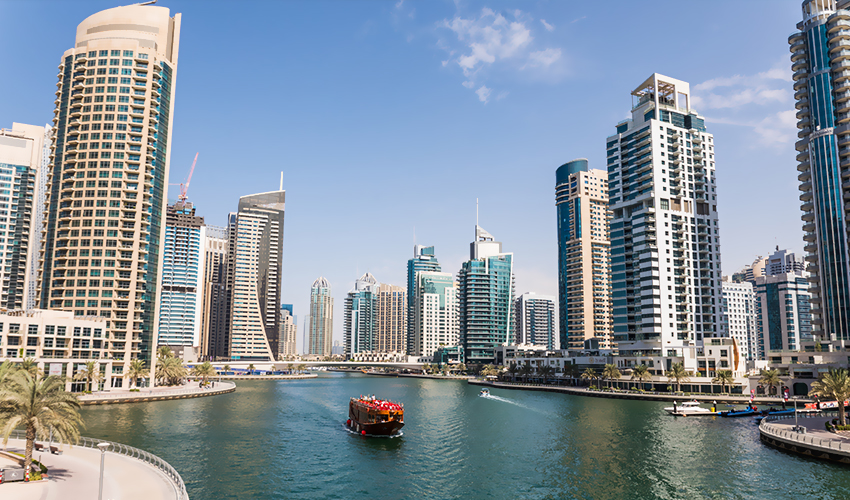

Dubai has become a leading destination for global investors who want stability and growth. Compared with other major cities, especially Western ones, it offers higher rental yields, favorable tax policies, and a more stable market environment.
Dubai is one of the world’s leading markets for property investment, and it has consistently outperformed many international hubs. Dubai’s real estate is recognized for its stability, diversity, and growth potential, which makes it an attractive and safe investment destination for both local and international buyers.
Introduction to Dubai
Dubai has established itself as a global city and a destination for foreign investors and property investors from around the world. Its real estate market has grown quickly, helped by its strategic location, modern infrastructure, and a business-friendly environment that welcomes global investors. Options range from luxury properties in prime locations like Palm Jumeirah to new investment opportunities in emerging neighborhoods. The tax structure is one of the city’s biggest advantages: zero personal income tax, no capital gains tax, and no inheritance tax (worth reading alongside our breakdown of the UAE's corporate tax rules). That lets investors keep more of their returns and safeguard their wealth.
Structural Stability, Not a Single Economic Snapshot
Global macro conditions shift from quarter to quarter (inflation eases, currencies move, central banks change course), so any snapshot of "the economic climate" goes stale fast. The better test for a safe haven is structural: does the destination hold up regardless of which way the macro winds are blowing this year? On that test, Dubai's fundamentals continue to hold. UAE inflation has stayed below global averages and is forecast at roughly 2.4% for 2026. The Central Bank projects real GDP growth of 1.6% for 2026 after the regional disruption, with a rebound to 10.4% forecast for 2027. Contained inflation, a projected growth rebound, and a currency anchored to the US dollar draw capital here in any given year, whatever the headline about the dollar or the Euro.
The Dollar Peg: A Structural Anchor, Not a Bet on Any One Currency
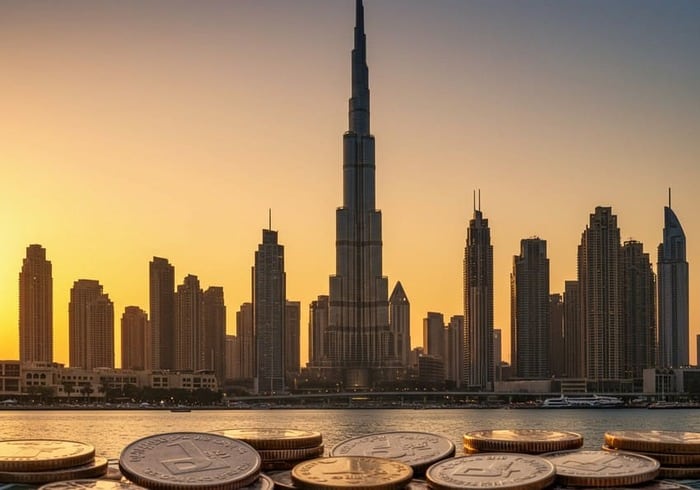
The UAE Dirham has been pegged to the US dollar for decades, and that peg remains one of the most consistently stable currency arrangements in emerging markets. It means the UAE Central Bank's own interest rate policy tracks the US Federal Reserve's moves directly, which gives investors currency-risk certainty that few other markets can match. Whatever direction the dollar itself is trending in a given year, the dirham moves with it in lockstep, so property values, rental income and capital in Dubai aren't exposed to the kind of independent currency risk that hits many other emerging-market destinations.
Many investors now treat diversifying wealth globally as a hedge, and Dubai’s economic fundamentals make it a sensible addition to a diversified portfolio. Incentives and exemptions in Dubai’s free zones and financial centers add to its appeal as a safe haven investment destination.
Political Instability Worldwide: What It Means for Investors
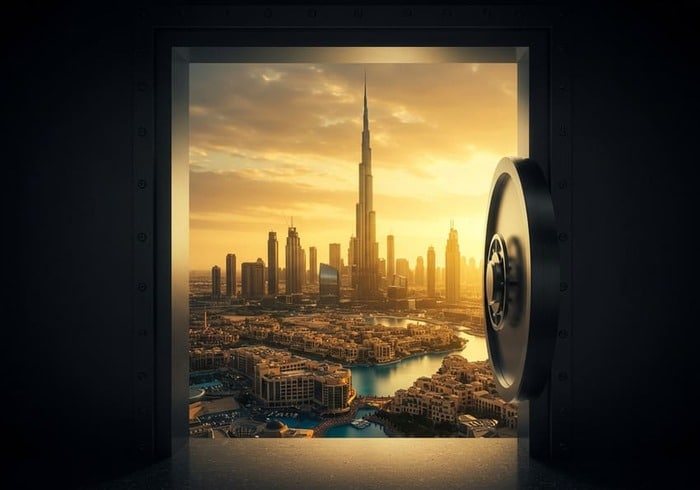
Countries facing political uncertainty (supply chain disruptions, rapid leadership changes, or legislative volatility) pose threats to property values. The UAE offers stability by contrast. The UAE government and Dubai government maintain it through investor-friendly policies, economic diversification, and long-term residency programs. That’s why Dubai real estate safe investment is gaining traction, especially compared to Western markets facing growing unpredictability. Dubai’s real estate market has stayed attractive through various market cycles, supported by ongoing demand and proactive government initiatives.
A fair reading has to include 2026. A regional conflict involving Iran began on 28 February and reached the UAE, disrupting flights, tourism and buyer confidence for several weeks. A ceasefire was announced on 8 April and Dubai’s airports are operating scheduled services again, but the wider security picture has stayed uncertain. Prices have eased: ValuStrat’s August index shows Dubai residential values down 3.1% on the year and about 10% below their level in late February. Safe haven here means durable fundamentals and legal protections over a long holding period, not a market that cannot fall. We follow how prices and demand are moving in our monthly market reports.
Dubai: A Stable Anchor Against Global Shocks
Dubai’s appeal goes beyond skyscrapers. The UAE economy stability, a robust legal system, no personal income tax, and the Dirham’s peg to the USD underlie its rise. Alongside the tight peg, Dubai’s broader market shows greater resilience. That makes it a useful option in currency risk management strategies. Demand for Dubai property is supported by modern infrastructure and sustained economic growth.
Dubai’s Competitive Advantage
Dubai’s competitive edge in the global real estate market rests on economic stability, political security, and investor-friendly policies. The city delivers high rental yields, which suits property investors who value steady income. See our breakdown of the factors affecting returns on real estate investments in the UAE. The tax-free environment and the absence of restrictions on foreign property ownership open the market to international investors. The Dubai International Financial Centre (DIFC) draws global capital and multinational businesses, which reinforces Dubai’s status as a hub for international trade and investment. Together with a secure environment and a robust legal framework, that lets investors build and preserve their wealth.
Global Capital and Business Hub
Dubai attracts international investors, entrepreneurs, and corporations from every corner of the world. It sits at the intersection of Europe, Asia, and Africa, which makes it a launchpad for businesses looking to reach new and emerging markets. Modern airports and seaports connect goods, services, and people. The UAE government’s investor friendly policies, such as golden visas and long-term residency options, add to Dubai’s appeal as a safe haven for global capital and investment. They give investors the security and flexibility they need in a rapidly changing world.
Real Estate Hedge Against Inflation
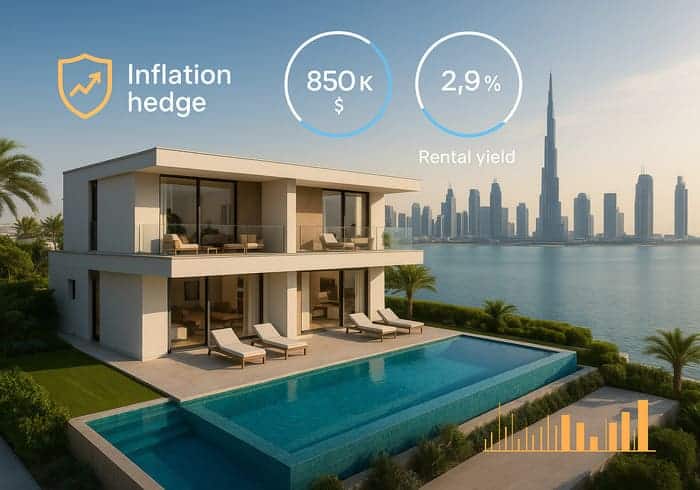
When inflation surges, real estate works as a hedge. See our comparison of gold vs real estate as an inflation hedge for how the two stack up. Property in Dubai has traditionally kept pace with or exceeded annual inflation, and that applies to a house for sale in Dubai UAE as much as to other Dubai homes for sale. Rent potential remains strong: a flat for sale in Dubai can yield 5 to 8% annually, offsetting inflationary pressures.
Both residential and commercial real estate in Dubai are considered strong property investments for inflation protection.
Global investors now see a real estate hedge against inflation as smart diversification, and Dubai fits that approach.
Dubai Property vs US Market
Comparing Dubai property vs US market shows these differences:
| Feature | Dubai | US |
|---|---|---|
| Ownership for foreigners | ✔️ | ✔️ (some restrictions) |
| Property tax | ❌ | ✔️ annually |
| Rental yields | 5 to 8% | 2 to 4% avg |
| Tenure | 99 years or freehold | Freehold/leasehold, varies |
| Golden / residency benefits | ✔️ Gold Visa available | ❌ |
Dubai offers no property tax, high rental yields, and a Dubai Golden Visa investment route, advantages not always available in the U.S.
Freehold properties give foreign investors full legal ownership rights, so they can buy, sell, and rent real estate freely, which adds to long-term investment security for families.
Capital Preservation Meets Lifestyle
Investing in Dubai isn’t just about finances. As a leading investment destination in the Middle East, Dubai offers lifestyle as well as financial advantages, thanks to its strategic location, economic stability, and role as a regional hub. Residents get healthcare, schools, leisure destinations, and tax-free living. So when investors ask “How to protect wealth from inflation?”, Dubai offers both financial security and quality of life, a rare combination.
Lifestyle and Amenities
Dubai’s real estate market reflects the city’s focus on luxury. Properties offer high-end amenities such as private beaches, golf courses, spas, and concierge services, and the city has five-star hotels and major shopping malls. For investors, that means luxury penthouses and busy city life in the same market. Our guide to penthouses for sale in Dubai shows what they cost in 2026 and what to check before you buy.
Family-Friendly Environment
Dubai is not only a hub for business and luxury. The real estate market offers properties designed with families in mind, with spacious layouts, private gardens, and community amenities like swimming pools and playgrounds. The city is safe and secure, with good schools and healthcare facilities. Dubai’s golden visa program and long-term residency options give families more certainty, since they can build a future in the city without concerns about immigration status.
Buying Dubai Property Online
Dubai’s digital push lets global buyers buy Dubai property online. The Dubai Land Department supports secure and transparent online property transactions by overseeing property registration and maintaining legal oversight.
From virtual home buying Dubai experiences to e-sign contracts and remote residency processing, purchasing property is now fully accessible, even from abroad.
This makes remote investing in UAE real estate, especially downtown Dubai property and penthouses, secure and straightforward, even without traveling physically.
The Case for Diversifying into Dubai
Dubai combines inflation protection with high rental returns and quality of life. Investors who diversify into it are choosing one of the more durable safe haven investments available today.
FAQ’s
Q. Can foreigners buy a house or flat in Dubai?
A. Yes, Dubai allows full property ownership in designated freehold zones for foreigners.
Q. How is Dubai property a hedge against inflation?
A. With rising property values and rental yields, real estate outpaces inflation long-term.
Q. Does buying property in Dubai help with a Golden Visa?
A. Yes, investments over AED 2 million typically qualify for a 10-year Golden Visa.
Q. Is Dubai safer than the U.S. for property?
A. With no taxes, stable governance, and high yields, Dubai is a compelling alternative.
Conclusion
Global economic conditions will keep shifting from year to year, but Dubai's underlying case doesn't depend on any single one of them. Its combination of political and economic stability, inflation-resistant real estate, residency benefits, and luxury living make it one of the strongest safe haven investments. If you’re eyeing a luxury house for sale in Dubai UAE or considering renting or buying in Dubai, Dubai delivers capital protection and lifestyle in one.